Written by: Flexing It
17/09/2026
6 minutes read
![eye]() 51
51
![share]() 0shares
0shares
Hiring a consultant comes with a small temptation: you ask them to show you how they think, and before you know it, they’re helping you solve the problem
A CV can tell you to summarise their career story. A portfolio can show you their impact. An interview can reveal how they talk about decisions, trade-offs and outcomes.
But sometimes, you need to see their thinking in motion.
That is where an approach note, case exercise or sample solution can earn its place in the selection process.
The difficulty is not deciding whether assignments are good or bad. It is deciding how much is enough.
As our Flexing It consultant Rashmi Tiwari puts it, she is comfortable sharing an approach when the aim is to understand how she “thinks, structures a problem, and gets to the root of it.”
The assignment shouldn’t be a trial run
Compare:
“How would you approach launching this product?”
with:
“We’re launching this product next month. Develop the campaign strategy, social plan and launch messaging.”
The first asks the consultant to open the door.
The second hands them the keys. The important word here is approach.
The difference can be only a few extra lines in the project brief.
Which raises a slightly uncomfortable question: haven’t you already seen enough?
For senior consultants, there is even more to consider.
A seasoned independent may arrive with years of case experience, a substantial portfolio and a history of solving complicated problems for organisations. Asking for yet another substantial piece of work can sometimes tell a client less, not more.
The question is:
What are we trying to learn that we don’t already know?
That might lead to a better kind of assessment.
Rather than asking for a finished strategy, explore how they have approached similar problems, what they would change, and how they would tackle a new one.
Vyom Agarwal, Independent Consultant, is more sceptical of assignments,
Usually, an assignment is either too time-consuming or straightforward ChatGPT-ish, which doesn't indicate my value over peers. I have seen only the underconfident consultant agree to do assignments; good ones usually reject such opportunities...so I refrain from entertaining these asks unless it's a highly desirable opportunity.
Every additional hour spent on an application counts toward that calculation.
The clock matters. Context matters more.
There is no scientifically correct number of minutes that turns an assignment from reasonable to unreasonable.
A short hypothetical exercise can create useful evidence. A detailed task involving research, analysis, creative development or multiple deliverables asks for something else.
Krishna Warrier, DEI leader, describes a reasonable request as one that is:
“Clearly defined, proportionate, and meant to understand how I think rather than extract free consulting.”
A two-hour exercise may be excessive for one role and entirely sensible for another. A 30-minute exercise may be pointless if the client already has all the evidence it needs.
The problem with using an active business problem
Take a live business challenge: for example, a customer or process problem that needs answers.
Now ask the shortlisted consultant to build the strategy around it.
The exercise may still be labelled an “assessment”. But the output is beginning to resemble consulting work.
Rashmi puts the distinction neatly:
“There’s a difference between asking someone to demonstrate how they would approach a problem and asking them to solve the problem before they’ve been engaged.”
It may be the easiest way to tell an assignment from work.
There is no one-size-fits-all view
Some consultants see an approach note as a normal part of establishing fit.
Krishna says broad approach requests are fairly common in his experience.
Vyom’s experience is very different: he says assignments arise in fewer than one in ten opportunities.
Rashmi describes it as potentially useful in an exploratory or discovery process, where putting an initial thought on the table can help both sides understand the problem and how they might work together.
Neither perspective cancels out the other.
There is no universal consultant reaction to an assignment. The quality of the request matters.
The better hiring assignment question
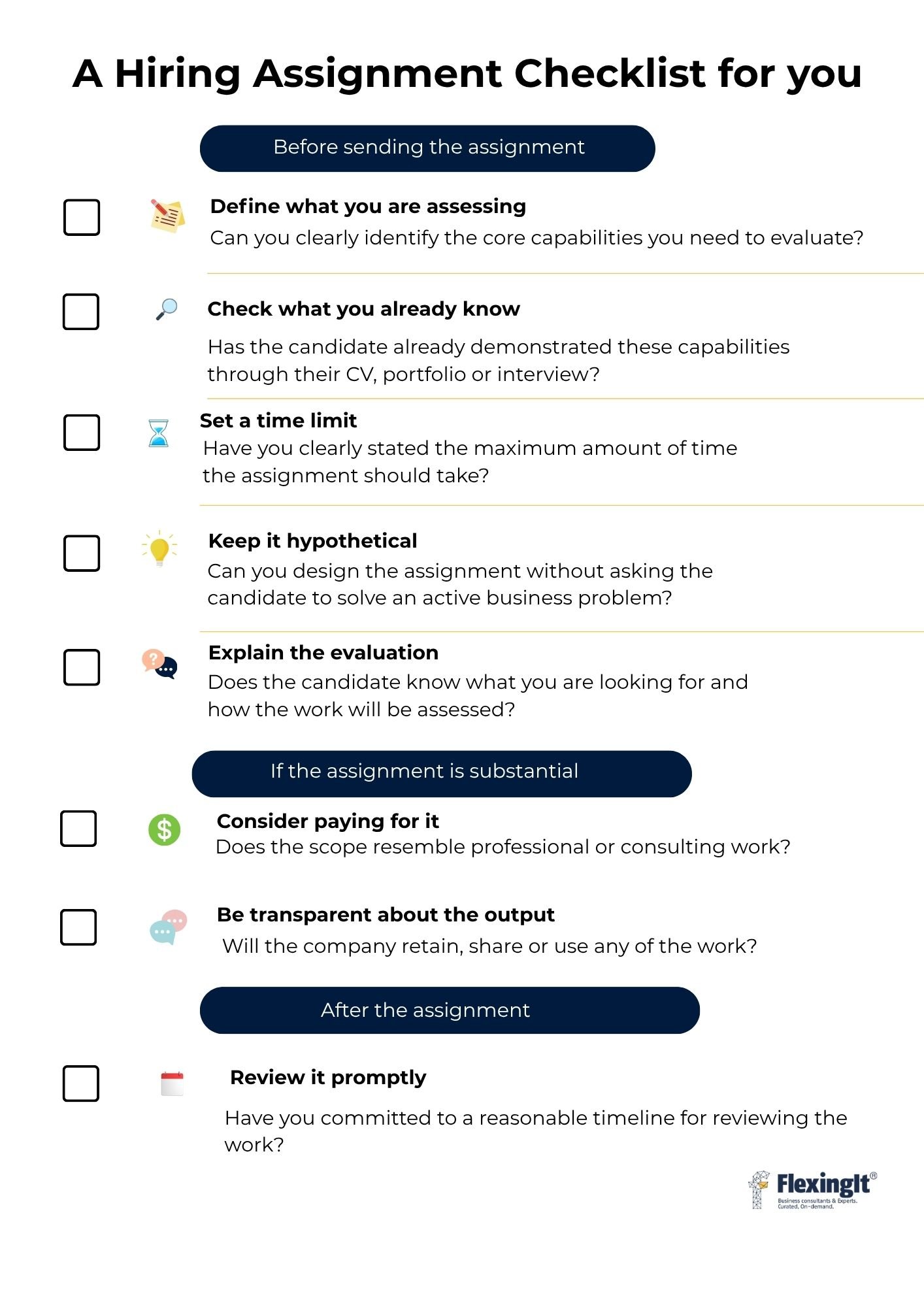
Before sending one, ask:
- What are we actually assessing?
- Has the consultant already demonstrated it?
- Could we make the problem hypothetical?
- Are we asking for an approach or a finished answer?
- How much time should this reasonably take?
Ideally, the exercise gives a client a little evidence of what someone can do, a glimpse of how they think, and enough to take the conversation towards a project.
Because hiring, at its best, is not an exam.
It is the beginning of a working relationship!


 `
`  51
51
 0shares